Data Tools
pandas loc vs iloc: select by label or by position
loc selects pandas rows and columns by label; iloc selects by integer position. See a side-by-side table, slicing rules, errors and examples you can run.
tutorial8 min read
Structured courses in Python, maths, statistics, machine learning, deep learning and generative AI. Every lesson takes you from the intuition and the maths to code you write and run on real data.
No credit card · Free lessons in every course · Certificate on completion
Courses
Classical machine learning and current generative AI, taught in order, so each course builds on the one before.
How every lesson teaches
Most courses stop at the library call. Each SchoolWhool lesson takes one idea all the way: why it works, the maths, your own implementation, and how it fails and is used at work.
Each lesson opens on a concrete problem and the idea that solves it, before any formula or library.
Only the maths a model needs, worked on small numbers and placed just before the lesson that uses it.
67 maths and statistics lessonsYou build the core models in plain Python and NumPy and check your numbers against scikit-learn, so fit() is never a black box.
101 notebooksModels are trained on real datasets, and a model has to beat a simple baseline before it counts.
The error you will actually see, why it happens and how to fix it, and where each method misleads.
113 lessonsReal-world applications for each idea, and case studies that take a business question to a compared set of models.
120 lessons with applications · 3 case studiesQuizzes marked as you answer, practice at three levels with values to check against, and module projects set as a problem with no template.
675 quiz questions · 24 projectsQuestions an interviewer asks about each module, with model answers, so you can say why a method works, not only how to call it.
515 questionsInside a lesson
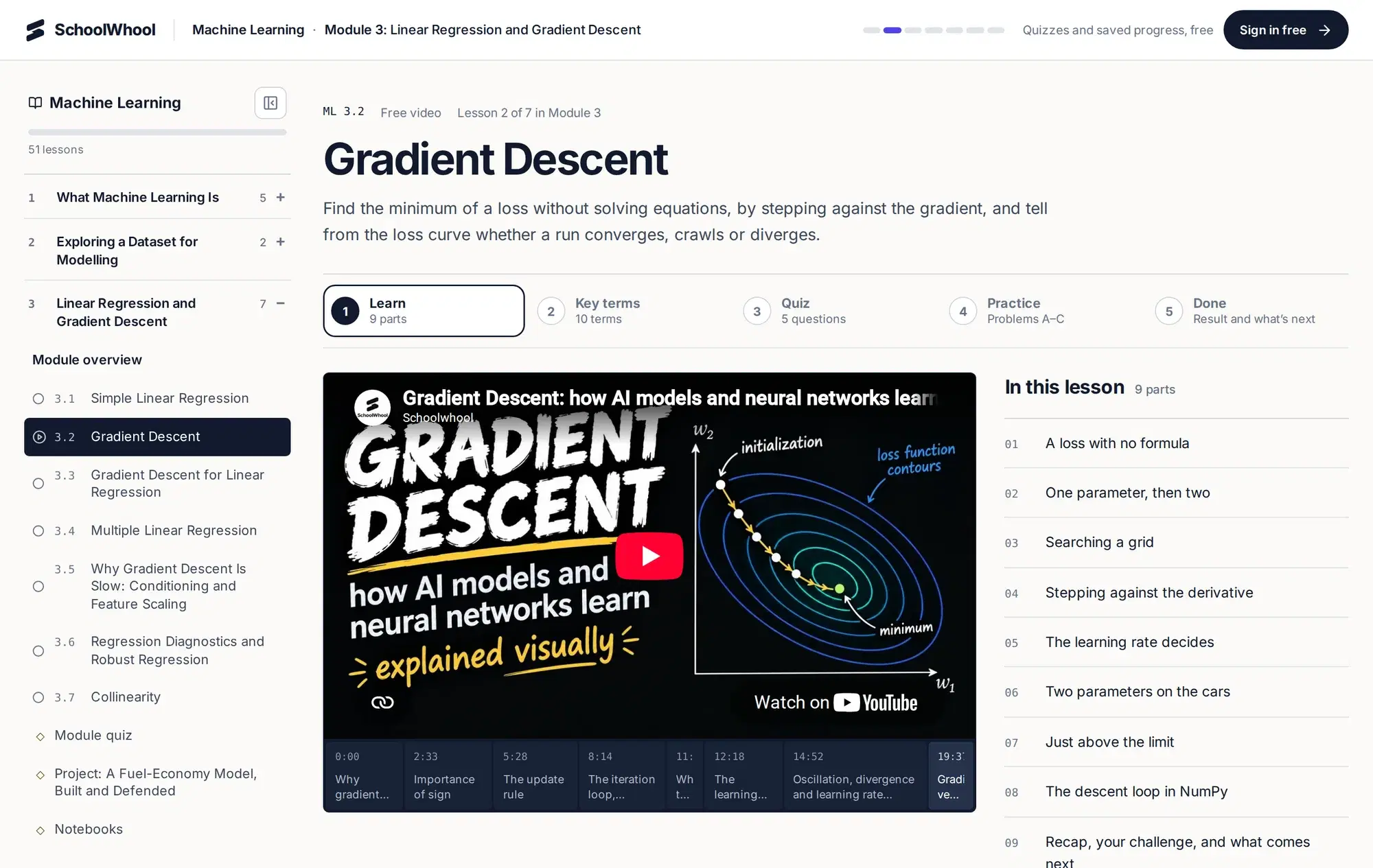
Watch the explanation with chapters, then work through the same ideas in a written walkthrough with the formulas and the code. Each lesson opens with the problem and ends with a challenge.
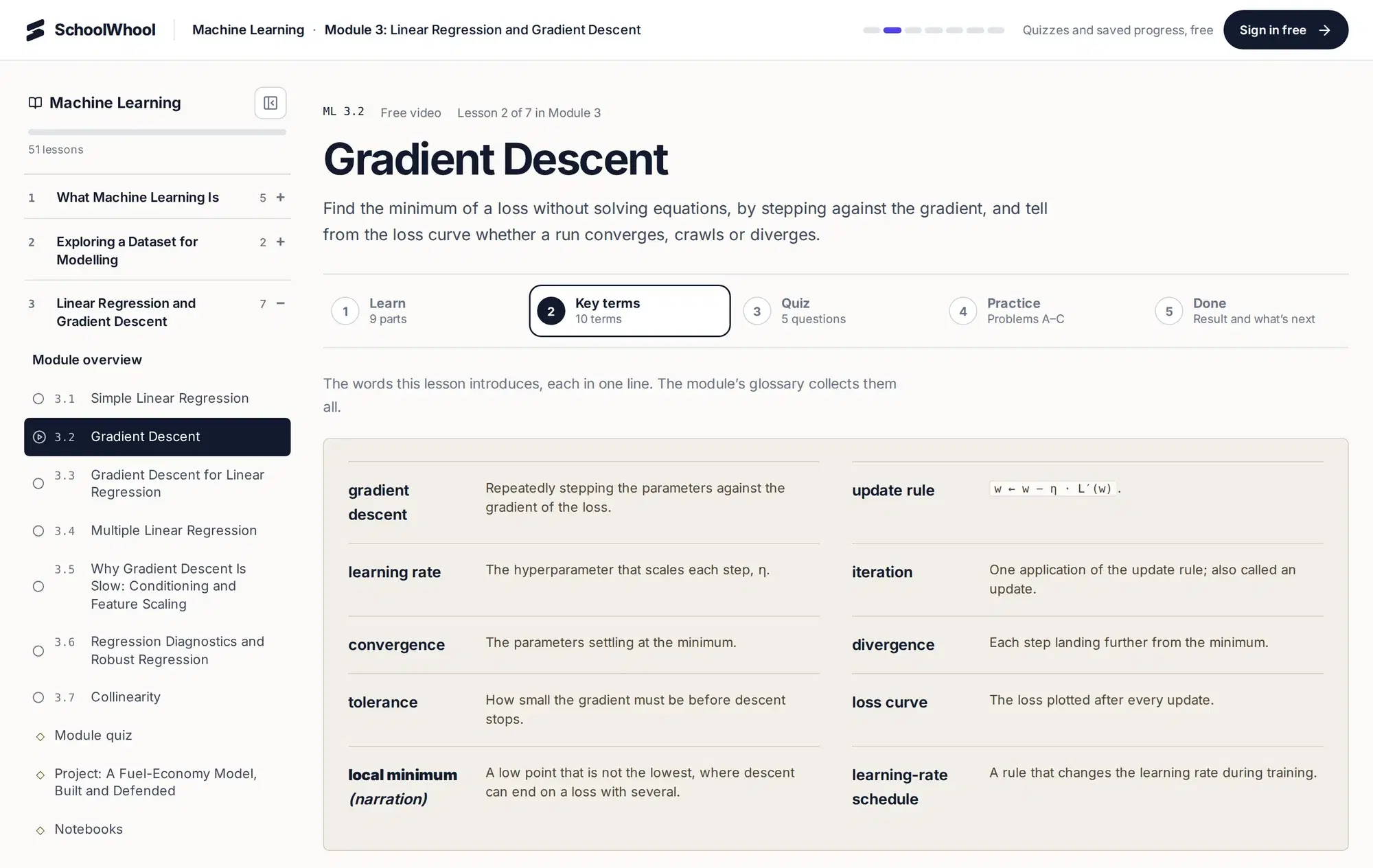
Each lesson lists the terms it introduces, each in one plain line, and links to the lessons it builds on. Together they make a searchable AI glossary.
Quizzes are marked the moment you answer. Practice comes at three levels with values to check, notebooks mark your code as you go, and every module ends in a project set as a problem, with no template.
Compare
Most ways of learning AI give you either the theory or the code. SchoolWhool gives you both, in order.
| What you need | Typical video course | Free tutorials | AI chatbots | SchoolWhool |
|---|---|---|---|---|
| Explains why it works | Often, slowly | Rarely | Generic answers | ✓ The intuition, then the maths |
| You build the model yourself | Rarely | Copy along | It writes it for you | ✓ From scratch, then the library |
| Real data and a baseline to beat | Toy examples | Sometimes | No | ✓ In every module |
| Tells you when you are wrong | Quizzes | No | No | ✓ Graded practice and notebooks |
| Interview preparation | No | Sometimes | Generic | ✓ Questions with model answers |
| One path from Python to generative AI | Separate courses | One topic | No path | ✓ 7 courses, in order |
| A live instructor | No | No | No | ✓ Weekly sessions and 1:1s |
A general comparison of common ways to learn, not of any one provider.
Live with your instructor

Gaurav Jain
Cofounder & CTO of an AI telehealth company · 6+ years building AI at startups · Research Published in Springer · Master's in Artificial Intelligence
Gaurav is an AI engineer and startup CTO. He has a Master's in Artificial Intelligence, has trained and shipped image-generation, computer-vision and LLMs models in production at startups, and has published deep-learning research.
Why Gaurav built SchoolWhool →A live walkthrough of a hard topic, open questions, and reviews of learners' code and projects.
Schedule announced soon · Included with Pro
A private session for career direction, a project review or a mock interview with feedback.
Book a session →Your order, or ours
Every course lists what it needs first, so you can start wherever you like. For a guided order, the machine learning path takes Python, Data Tools, Maths, Statistics, Machine Learning in 15 stages, each ending in a checkpoint you can test yourself against.
Certificates
Finish the lessons, pass the quizzes and complete the projects to earn a certificate with a link anyone can use to verify it. Add it to LinkedIn and your CV.
Pricing
₹0
Pricing announced soon
Pricing announced soon
loc selects pandas rows and columns by label; iloc selects by integer position. See a side-by-side table, slicing rules, errors and examples you can run.
tutorial8 min read
Permutation feature importance is how far a model's score drops when one feature is shuffled. Python code, a comparison with MDI and grouped shuffles.
tutorial8 min read
model.eval() switches dropout and batch norm to inference behavior; torch.no_grad() stops gradient tracking. Use both to validate, with checked code.
troubleshooting7 min read
fit learns from training data, transform applies that learning, predict outputs answers. See a table, runnable code and why test data gets transform only.
tutorial8 min read
Machine learning interview questions with worked answers: splits, leakage, precision and recall, baselines, gradient descent and regularisation, in Python.
interview guide10 min read
Data leakage is when a model learns from information it won't have at prediction time. See target, preprocessing and time leakage examples, and fixes.
troubleshooting9 min read
Also free: the AI glossary, cheat sheets and guides to machine learning in 109 fields.
No. The Python, Maths and Statistics courses start from the beginning, and every lesson links to the earlier lessons it builds on, so you can fill a gap when you meet it.
Every published lesson and video, the key terms, the AI glossary and the free cheat sheets, with no account. A free account adds the quizzes, saved progress and the opening modules of every course in full.
The practice that makes each lesson stick: problems at three levels with values to check, self-checking notebooks, module projects, cheat sheets, interview answers, certificates and the weekly live sessions with Gaurav.
Pro members join a weekly live session with Gaurav: a walkthrough of a hard topic, open questions and reviews of learners' code. One-to-one sessions are booked separately, for career direction, a project review or a mock interview.
Yes. Complete a course's lessons, quizzes and projects to earn a certificate for it, with a link anyone can use to check it.
No. Lessons and quizzes run in your browser, and the notebooks open in Google Colab.
Free to start, no credit card. Pick a course, or begin with Python and follow the path.